|
79Score
Getting your Trinity Audio player ready...
|
In the PTE exam, your understanding of the English language is tested in various ways. One thing common to all the sections is the vocabulary. Most people preparing for the PTE exam might understand grammar rules, but often struggle with the vocabulary section. So, to help you with that, here is a PTE vocabulary list that you can learn and use.
Why Vocabulary Matters in PTE
Before you start practicing with the PTE mock test online, understand where vocabulary is actually scored. It is not a separate line on your score report. Since the August 2025 update the report shows only the four communicative skills, and vocabulary is marked inside tasks: Vocabulary (0 to 2) in Summarize Written Text and Summarize Spoken Text, Vocabulary Range (0 to 2) in Write Essay, and word appropriacy in Answer Short Question, according to the PTE Academic Score Guide. Also, every Fill in the Blanks question in Reading and Listening is a vocabulary question scored per blank.
- Speaking: precise words let you describe an image or retell a lecture without hunting for the right term.
- Writing: word choice is a scored trait in all three writing tasks.
- Reading: Fill in the Blanks and Reorder Paragraphs both test your ability to recognize collocations and linking words.
- Listening: you can only write the word you hear if you already know it; spelling it correctly is what earns the point.
A strong vocabulary gives you fluency, accuracy, and confidence at the same time.
PTE Vocabulary List 2026
| Word | Meaning | Synonyms | Antonyms |
| Abhorrent | Inspiring disgust | Repulsive, detestable, loathsome, odious | Appealing, delightful, attractive |
| Accessible | Easy to approach or obtain | Attainable, reachable, obtainable, approachable | Inaccessible, unattainable, remote |
| Accountable | Responsible for actions | Answerable, liable, responsible, obligated | Irresponsible, exempt, unaccountable |
| Admissible | Acceptable in law or logic | Permissible, allowable, valid, acceptable | Inadmissible, unacceptable, invalid |
| Amicable | Friendly and peaceful | Cordial, harmonious, congenial, affable | Hostile, antagonistic, unfriendly |
| Applicable | Relevant or appropriate | Pertinent, relevant, suitable, apt | Irrelevant, inapplicable, inappropriate |
| Arbitrable | Able to be settled by arbitration | Negotiable, resolvable, adjustable | Non-negotiable, irreconcilable |
| Auditable | Able to be examined officially | Verifiable, inspectable, reviewable | Unverifiable, untraceable |
| Authenticable (better: authentic) | Capable of being verified | Genuine, verifiable, credible, legitimate | Fake, counterfeit, dubious |
| Bearable | Tolerable | Endurable, manageable, tolerable, sufferable | Intolerable, unbearable, insufferable |
| Cognizable | Able to be recognized legally | Noticeable, perceptible, recognizable, detectable | Indiscernible, unnoticeable |
| Compatible | Able to coexist harmoniously | Congruent, consistent, harmonious, agreeable | Incompatible, inconsistent, conflicting |
| Comprehensible | Able to be understood | Intelligible, lucid, coherent, explicit | Incomprehensible, obscure, ambiguous |
| Conceivable | Possible to imagine | Imaginable, plausible, thinkable, credible | Inconceivable, impossible, implausible |
| Conformable | Able to comply | Despicable, disgraceful, vile, shameful | Admirable, respectable, honorable |
| Credible | Believable | Plausible, convincing, trustworthy, reliable | Implausible, unbelievable, dubious |
| Decipherable | Able to be interpreted | Interpretable, readable, understandable, resolvable | Indecipherable, obscure, confusing |
| Defensible | Justifiable | Justifiable, tenable, supportable, valid | Indefensible, unjustifiable, weak |
| Delectable | Highly pleasing (taste) | Delicious, savory, appetizing, delightful | Unpalatable, tasteless, unpleasant |
| Demonstrable | Able to be proven | Provable, verifiable, confirmable, evident | Unprovable, doubtful, uncertain |
| Despicable | Worthy of hatred | Contemptible, vile, loathsome, disgraceful | Admirable, noble, commendable |
| Discernible | Able to be perceived | Detectable, noticeable, perceptible, observable | Indiscernible, invisible, unclear |
| Disputable | Open to argument | Debatable, questionable, controversial, arguable | Undisputed, certain, unquestionable |
| Durable | Long-lasting | Resilient, sturdy, robust, enduring | Fragile, perishable, weak |
| Eligible | Qualified | Entitled, fit, competent, suitable | Ineligible, unqualified, disqualified |
| Enforceable | Able to be imposed legally | Binding, executable, compulsory, valid | Unenforceable, optional, void |
| Expendable | Able to be sacrificed | Replaceable, dispensable, nonessential, redundant | Indispensable, essential, vital |
| Explicable | Able to be explained | Interpretable, understandable, rational, logical | Inexplicable, mysterious, incomprehensible |
| Feasible | Possible to do | Viable, workable, practicable, achievable | Infeasible, impractical, impossible |
| Flexible | Able to adapt | Adaptable, pliable, versatile, adjustable | Rigid, inflexible, fixed |
| Formidable | Inspiring fear/respect | Intimidating, daunting, powerful, impressive | Weak, insignificant, unimpressive |
| Inevitable | Certain to happen | Unavoidable, inescapable, certain, destined | Avoidable, uncertain, unlikely |
| Indispensable | Absolutely necessary | Essential, crucial, vital, necessary | Optional, unnecessary, dispensable |
| Infallible | Incapable of error | Faultless, flawless, perfect, impeccable | Fallible, imperfect, flawed |
| Legible | Easy to read | Gainful, profitable, rewarding, beneficial | Unprofitable, loss-making, futile |
| Manageable | Easy to control | Controllable, handleable, workable, feasible | Unmanageable, difficult, chaotic |
| Negligible | Too small to matter | Insignificant, trivial, minimal, minor | Significant, considerable, substantial |
| Perceptible | Able to be noticed | Detectable, noticeable, observable, discernible | Imperceptible, invisible, unnoticeable |
| Plausible | Seemingly reasonable | Credible, believable, probable, convincing | Implausible, unlikely, doubtful |
| Predictable | Expected | Foreseeable, anticipated, certain, expected | Unpredictable, random, uncertain |
| Preferable | More desirable | Favorable, superior, advantageous, desirable | Undesirable, inferior, disadvantageous |
| Questionable | Doubtful | Dubious, uncertain, suspicious, disputable | Certain, reliable, unquestionable |
| Reversible | Able to be undone | Changeable, alterable, modifiable, adjustable | Irreversible, permanent, fixed |
| Sustainable | Maintainable long-term | Viable, enduring, supportable, renewable | Unsustainable, temporary, exhaustible |
| Tenable | Able to be defended | Defensible, justifiable, valid, supportable | Untenable, indefensible, weak |
| Traceable | Able to be tracked | Detectable, identifiable, followable, monitorable | Untraceable, hidden, unidentifiable |
| Viable | Capable of working | Feasible, workable, practical, achievable | Unviable, impractical, impossible |
If you have a strong command over vocabulary, careers like law and journalism can be a great fit for your aptitude. However, choosing the right career is not always straightforward, as it requires a deeper understanding of your interests, personality, and long-term goals. Taking a scientific career assessment test along with professional career counselling can help you make a more informed decision. To gain clarity and confidently select the right career path and course for studying abroad, you can explore career guidance and personalized support at expert career counselling services by Allegiance Educare.
Tips To Enhance Vocabulary For PTE Exam
Most students memorize a long list of difficult words and forget nearly all of them within a week. The tips below are about retention, and you can test how well they are working on a PTE practice test. Read regularly, with the right approach. Reading improves vocabulary only when you focus on understanding context instead of translating every word.
Add this bullet as the second tip in the list:
- Learn collocations, not single words: PTE Fill in the Blanks is built on word partnerships such as “conduct research” or “raise awareness”. Knowing which words go together is what lets you pick the right option quickly. Start with our list of collocations for PTE.
- Learn words with understanding and context: Focus mainly on academic words and practice using them in sentences.
- Avoid using difficult vocabulary unnecessarily: Good vocabulary never means you have to use difficult words. Use synonyms and antonyms wherever needed.
- Focus on topic-based vocabulary: Most of the questions in PTE are around an academic theme, so prepare theme-wise so that you will be able to respond more confidently.
- Actively use new words in speaking: Speaking helps you recall words quickly and use them under time pressure, which is exactly what happens in the exam.
- Read regularly with the right approach: Reading improves vocabulary only when you focus on understanding context instead of translating every word. This builds your ability to recognize meaning naturally and improves comprehension speed.
- Revise consistently: learning new words once is not enough. Without revision, you will forget them. Repeated exposure strengthens memory and ensures you can recall words during the test.
- Practice writing regularly: Writing helps reinforce vocabulary by forcing you to use it actively. It also improves sentence structure and overall expression, which are important for scoring well.

Not sure where you stand? Take a free PTE mock and find out instantly


- Get a complete performance breakdown instantly
- Access 30,000+ Free Question Wise Practice
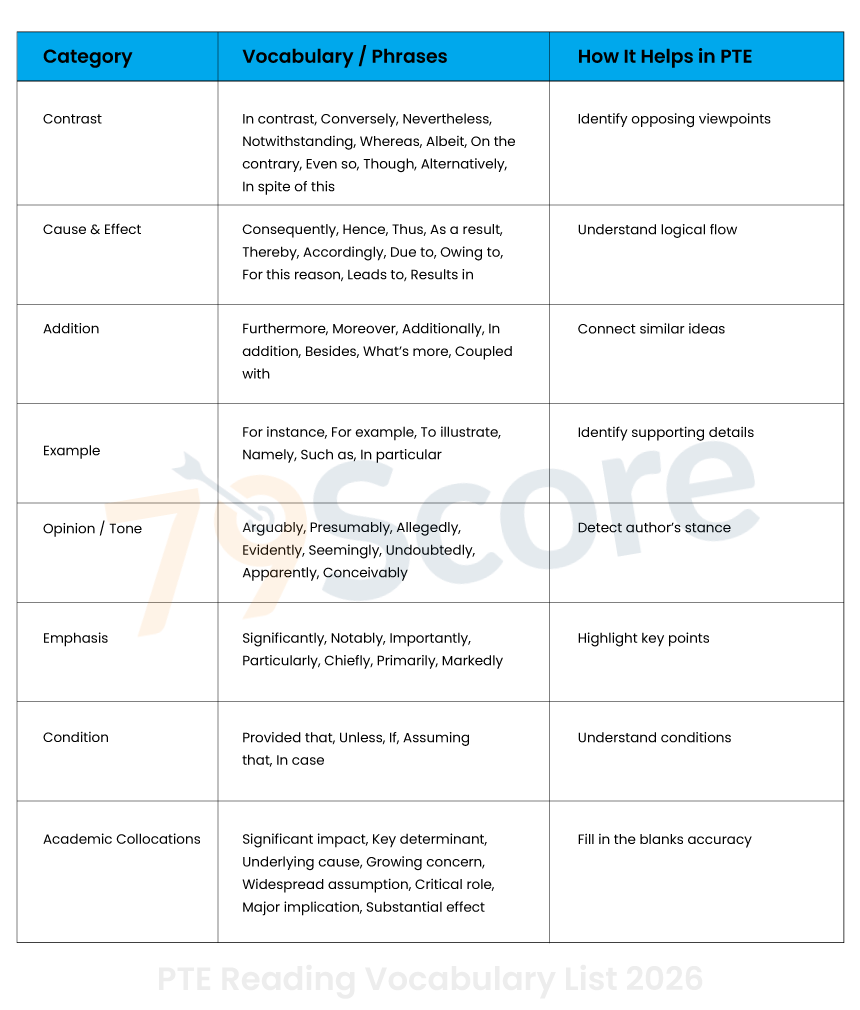
PTE Reading Vocabulary List: Linking Words and Context Clues
Reading in PTE is less about rare words and more about the words that hold a text together. Reorder Paragraphs is solved by spotting which sentence can stand first and which must follow. Fill in the Blanks is solved by recognizing the word that fits the grammar and the logic around the gap. These are the words to know cold.
PTE Speaking Vocabulary List: Key Phrases for Each Task
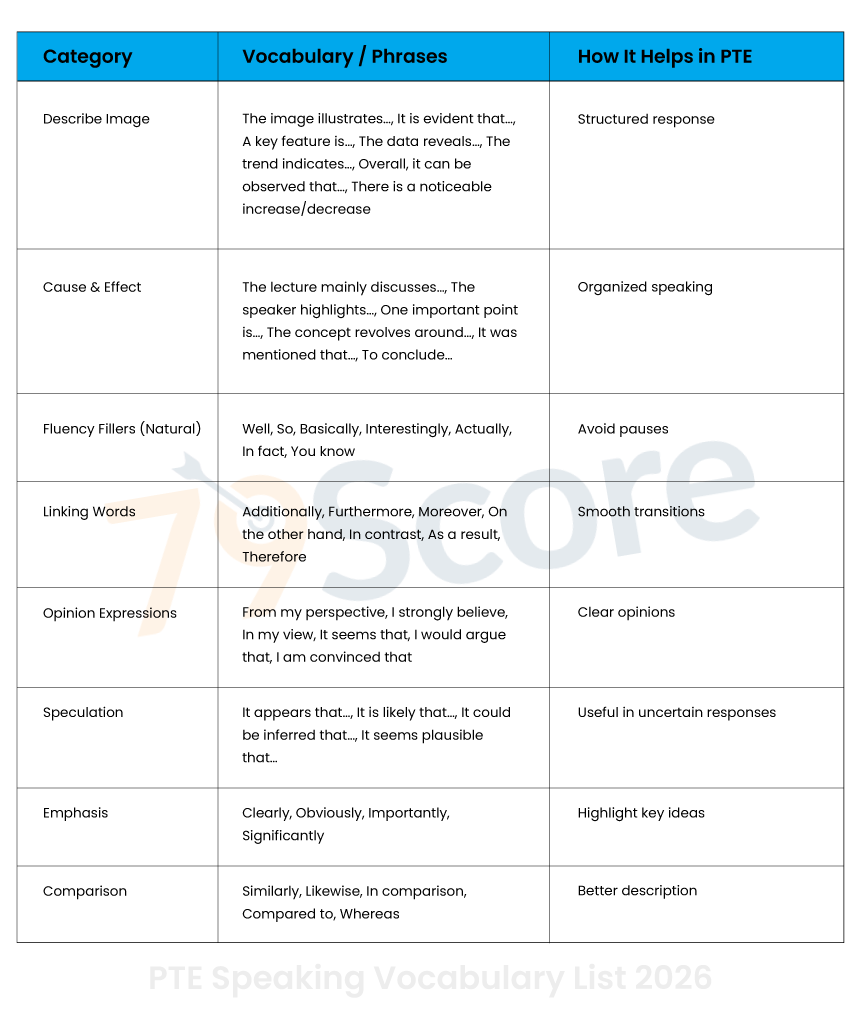
Speaking tasks reward fluency, and fluency comes from not having to think about the frame. Learn one opening, two detail phrases and one closing phrase for each task so your attention stays on the content.
Not sure where you stand? Take a free PTE mock and find out instantly
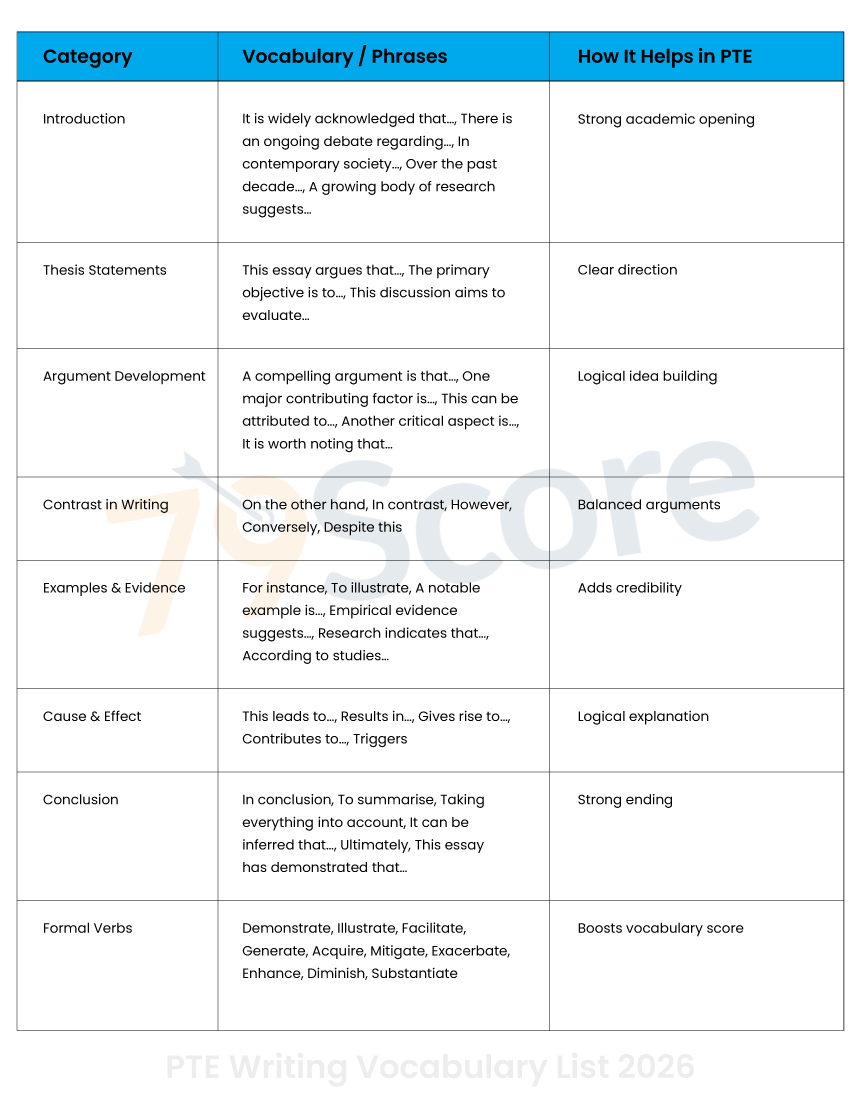
PTE Writing Vocabulary List: Academic Expressions for Essays and Summaries
Vocabulary Range in the essay is scored on variety and appropriateness in an academic setting, and Pearson notes that the best responses use precise academic terms and avoid repetition. These expressions give you the variety; the ideas still have to be yours. To practice PTE essay writing effectively, focus on using a range of precise academic vocabulary while keeping your ideas clear and relevant to the essay topic.
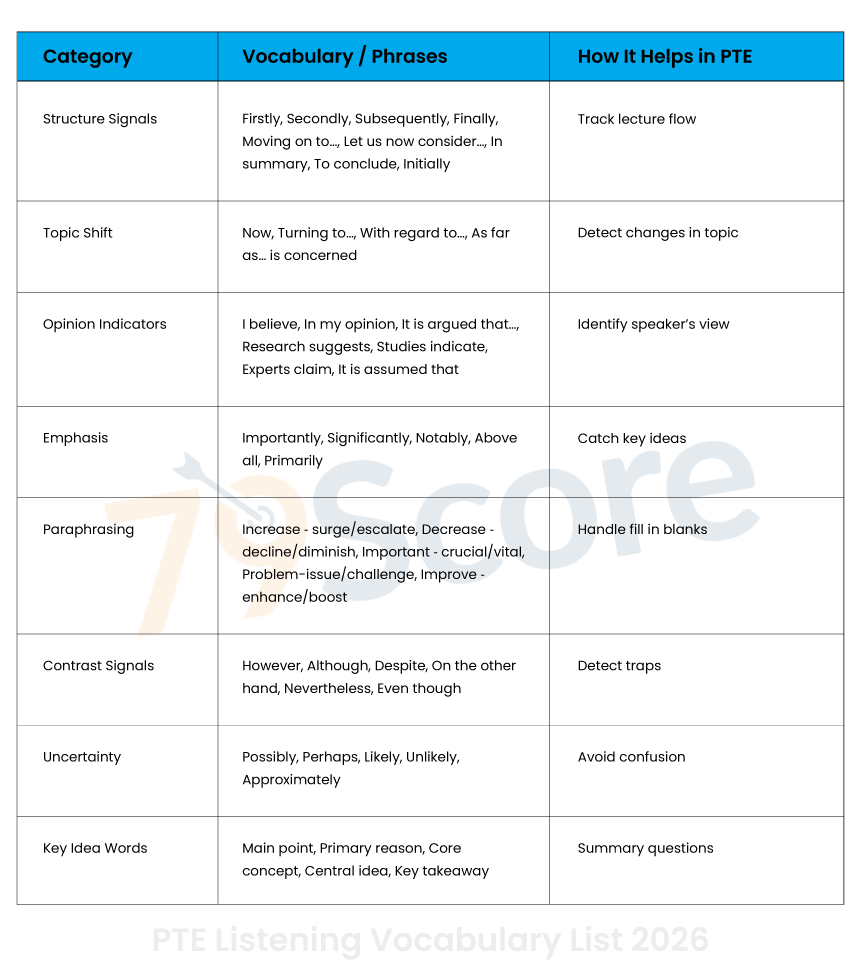
PTE Listening Vocabulary List: Signposts and Words You Must Spell
Listening vocabulary works in two directions. Signposting words tell you where the main point is about to land, which is what the Summarize Spoken Text and Multiple Choice test. Spelling vocabulary is about writing exactly what you heard, which is what Write from Dictation and Fill in the Blanks score. Practicing common PTE dictation words can help you recognize and spell frequently tested words more accurately.
You can also improve your performance by practicing more questions on a reliable PTE test preparation website like 79score. It provides full-length mock tests as well as section-wise practice tests, so you can focus on each area individually. Plus, you can take advantage of their expert-curated knowledge zone and access over 30,000 practice questions to strengthen your preparation.
FAQ:
How to improve vocabulary for PTE?
Build vocabulary through common academic words, collocations, synonyms, and words you repeatedly encounter in PTE practice questions. Instead of memorizing difficult words randomly, learn how they are used in context. This is particularly useful for Reading Fill in the Blanks and writing tasks, where vocabulary, grammar, and context all matter.
Is vocabulary scored separately in PTE?
Vocabulary is one of the scoring criteria in several PTE tasks, rather than a separate section where you answer vocabulary questions. Your word choice, relevance, appropriateness, and use of synonyms can contribute to your score in tasks such as Summarize Written Text and Summarize Spoken Text.
How many words do I need to learn for PTE?
There is no fixed number of vocabulary words you must learn for PTE. Focus on learning useful academic vocabulary, common collocations, and words that frequently appear in your practice. Understanding how a word works in a sentence is generally more useful than memorizing a very large word list.
Which PTE tasks depend most on vocabulary?
Vocabulary is particularly useful in Reading Fill in the Blanks, Summarize Written Text, Summarize Spoken Text, and essay writing. For Reading Fill in the Blanks, understanding context, grammar, and common word combinations can help you identify the correct answer.
Should I use British or American spelling in PTE?
You can use British, American, Australian, or Canadian spelling in PTE. The important point is to use one spelling convention consistently within your response.
Does using difficult words improve my PTE score?
Not necessarily. Using a difficult word incorrectly can hurt the quality of your response. Focus on precise, relevant, and appropriate vocabulary rather than trying to make every sentence sound complicated. Pearson's guidance emphasizes appropriate word choice and effective use of synonyms.
Also Read: