|
79Score
Getting your Trinity Audio player ready...
|
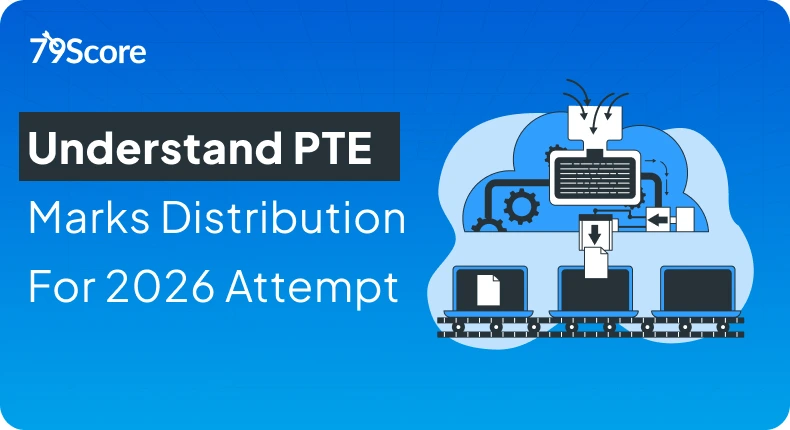
Before starting preparation for the PTE exam, you must understand the scoring system, as it helps you make a streamlined plan. According to the August 2025 update, there were several changes to the PTE Academic exam in terms of scoring. So all those who are attempting this exam in 2026 understand the changes and PTE marks distribution among all the sections.
By knowing the scoring criteria in depth, you will be able to do effective practice on 79Scores’s PTE full length mock test. Let’s start with understanding the changes section-by-section.
The PTE exam is divided into four section:
Each of these is scored on a scale from 10 to 90. But these scores are not calculated in isolation. What actually determines your marks is how you perform in individual tasks. So instead of thinking- “Marks come from sections”, It’s more accurate to think – “Marks come from tasks inside those sections”. One response can affect more than one skill
How PTE Marks Distribution is Done?
This is one of the most important things to understand. In PTE, a single answer can contribute to multiple skills at the same time. This is because the exam is designed to reflect how language works in real life, where reading, listening, speaking, and writing are often connected.
For example:
When you write what you hear, you’re using listening and writing
Because of this, your performance in one task doesn’t just stay in one section. It can influence multiple scores together.

Not sure where you stand? Take a free PTE mock and find out instantly


- Get a complete performance breakdown instantly
- Access 30,000+ Free Question Wise Practice
PTE Marks Distribution Chart (For Academic)
Speaking Section:
| Task | No. Of Questions | Skills Measured | Scoring Detail |
| Read Aloud | 6-7 | Speaking | Content, Pronunciation (0–5), Oral Fluency (0–5). Now contributes only to Speaking, not Reading. |
| Repeat Sentence | 10-12 | Speaking, Listening | Content (0–3), Pronunciation (0–5), Fluency (0–5). |
| Describe Image | 5-6 | Speaking | Content (0–6), Pronunciation (0–5), Fluency (0–5). Human review now checks content. |
| Retell Lecture | 2-3 | Speaking, Listening | Content (0–6), Pronunciation (0–5), Fluency (0–5). Human-reviewed. |
| Summarize Group Discussion (NEW) | 2-3 | Speaking, Listening | Summarize viewpoints from 2–3 speakers. Content (0–6) + delivery traits. Human-reviewed
|
| Respond to a Situation (NEW) | 2-3 | Speaking | Role play everyday scenarios. Content (0–6), Pronunciation, Fluency. Human-reviewed. |
| Answer Short Question | 5-6 | Listening Only | Scored 1/0 based on vocabulary appropriacy. Now feeds Listening, not Speaking. |
Writing Task:
| Task | No. Of Questions | Skills Measured | Scoring Detail |
| Summarize Written Text | 2 | Reading + Writing | Content (0–4), Grammar (0–2), Vocabulary (0–2), Form (1/0). Human-reviewed for content. |
| Write Essay | 1 | Writing | Content (0–6), Development/Structure/Coherence (0–6), General Linguistic Range (0–6), Form (0–2). Human-reviewed. |
Reading Section:
| Task | No. Of Question | Skills Measured |
| Reading: Fill in the Blanks (dropdown) | 5-6 | Reading |
| Multiple-choice, Multiple answers | 2-3 | Reading |
| Re-order paragraphs | 2-3 | Reading |
| Fill in the Blanks (drag-drop) | 4-5 | Reading |
| Multiple-choice, Single answer | 2-3 | Reading |
Listening :
| Task | No. Of Questions | Skills Measured | Scoring Detail |
| Summarize Spoken Text | 1 | Listening & Writing | Content 0–4, Grammar 0–2, Vocabulary 0–2, Spelling 0–2, Form 0-2; human content review. |
| Multiple-choice, Multiple answers | 2-3 | Listening | Partial Credit |
| Fill in the Blanks (type-in) | 2-3 | Listening | Partial Credit |
| Highlight Correct Summary | 2-3 | Listening & Reading | Partial Credit |
| Multiple-choice, Single answer | 2-3 | Listening | Partial Credit |
| Select Missing Word | 1-2 | Listening | Partial Credit |
| Highlight Incorrect Words | 2-3 | Listening & Reading | Partial Credit |
| Write From Dictation | 3-4 | Listening & Writing | Partial Credit |
PTE Marking Criteria
There isn’t a fixed “marks table” released that assigns exact numbers to each question type. Instead, marks are distributed across the test based on how each task is evaluated.
Some tasks appear multiple times, while others appear only once or twice. Naturally, the ones that appear more often end up contributing more to your overall score, not because they are officially labelled as more important, but because you encounter them more frequently.
So your total score is really a combination of:
- How well you perform in each attempt.
- Which skills is that task connected to.
- How your answers are evaluated.
How much weightage does the task contribute?
Each response you give is assessed based on certain criteria. It’s not just about whether your answer is right or wrong.
For speaking, things like:
- Content
- Oral Fluency
- Pronunciation
For writing, the focus shifts to:
- Content
- Grammar
- Vocabulary
- Structure
- Development Structure/Coherence
- General Linguistic Range
- Form
And in listening or reading tasks, accuracy plays a major role, especially when it comes to choosing or typing the correct words. What’s helpful here is that many tasks allow partial scoring. That means even if your answer isn’t perfect, you can still earn marks for the parts you get right.
What Affects Your Scoring :
In PTE, even the smallest mistake affects. Because of how the scoring works, even small things can make a difference over time. For instance:
- Missing a word in dictation
- Hesitating too much while speaking
- Making repeated spelling errors
Individually, these might not seem like big issues. But across multiple questions, they can gradually lower your score.
Mistakes to Avoid:
A common experience among test-takers is putting in a lot of effort but not seeing the expected improvement. Often, the reason isn’t lack of practice, it’s lack of clarity about how marks are actually distributed. If you focus only on sections, you might miss the fact that:
- Some tasks appear more often
- Some tasks affect more than one skill
- Some mistakes repeat across multiple questions
Once you start looking at the exam through tasks instead of sections, the pattern becomes easier to understand.

How To Score High In PTE Exam
Instead of dividing your preparation strictly into speaking, writing, reading, and listening, pay attention to the types of questions you are practicing. Ask yourself:
- Am I consistent in the tasks that appear frequently?
- Am I making the same mistakes again and again?
- Am I improving accuracy as well as fluency?
This approach keeps your preparation aligned with how the exam actually evaluates you. PTE doesn’t reward isolated understanding. It checks how effectively you can use language in connected contexts. That’s why scores are distributed across tasks rather than fixed in sections. Your final result is built gradually, through every response you give throughout the exam.
If you want to boost your score, try practicing on 79Score. Our PTE learning platform offers a full-length mock test with instant and reliable scoring, helping you understand exactly where you stand. You can also work on section-wise tests to improve specific areas. Make the most of one free mock test and access over 30,000+ practice questions. With detailed performance analysis, you’ll be better equipped to achieve a high score.